
At Sophie, the student talks to discuss and writes to think. The conversation happens out loud. The working happens on paper, by hand, and Sophie reads the page.
That surprises people. Most expect online tutoring today to be a chat box: type a question, get an answer. A chat box puts both jobs into one text field, and the thinking ends up done by the machine. We split them on purpose.
We have written about the writing half before, in Why we put writing first. This essay covers both halves: why talk, why write, and the five rules that follow.
Two jobs, two tools
- On ChatGPT, you type to ask, and the machine does the thinking.
- With Sophie, you talk to discuss, but you write the thinking.
Figure 1
Where the talking goes, and where the thinking goes.
| To discuss | To think | |
|---|---|---|
| Sophie | Speak | Write |
| ChatGPT | Write | Nothing |
It's optimal, because (A) talking is the fastest way to work with a machine, and (B) it's when you write that you think. Each half has its own reasons.
Why talk to discuss
A conversation should cost nothing. Questions, doubts and "wait, why?" need to come out the moment they show up.
- Talking is three times faster. In a Stanford study, people spoke short messages about three times faster than they typed them on a phone: 153 words a minute against 52.1 A question that takes half a minute to type takes ten seconds to say. When asking is cheap, students ask.
- Hands and eyes stay on the page. To type, a student puts the pencil down and looks away from their work. To talk, they don't. They can ask for help with the pencil still on the line.
- Saying it out loud shows what you understand. In a classic 1994 study, eighth graders who explained a science text out loud, line by line, understood it better than classmates who read it twice. The ones who explained the most learned the most.2 Psychologists call it the self-explanation effect. When a student has to say why a step works, the gaps show up fast, for them and for the tutor.
- Tutoring has always been a conversation. The tutor asks, the student explains, the tutor listens and asks again. Sophie keeps that shape. More on why tutoring works in The 2 sigma problem.
But talk has a limit. Nobody can hold six lines of algebra in the air. Say a derivation out loud, and by step three, step one is gone. A conversation is the right place to discuss a problem. It is the wrong place to work one.
Why write to think
On paper, every step stays in view. The student builds the next line on the last one, and nothing has to be held in the head. That is the job talk can't do.
Writing is also dense and self-reflective. To put a step down, the student has to pull the rule back out of memory and decide what comes next. It's when you write that you think.
Writing > Typing
Writing a letter by hand pulls in more of the brain than typing it.
Figure 2
Brain areas used in handwriting (left) and in typing (right).
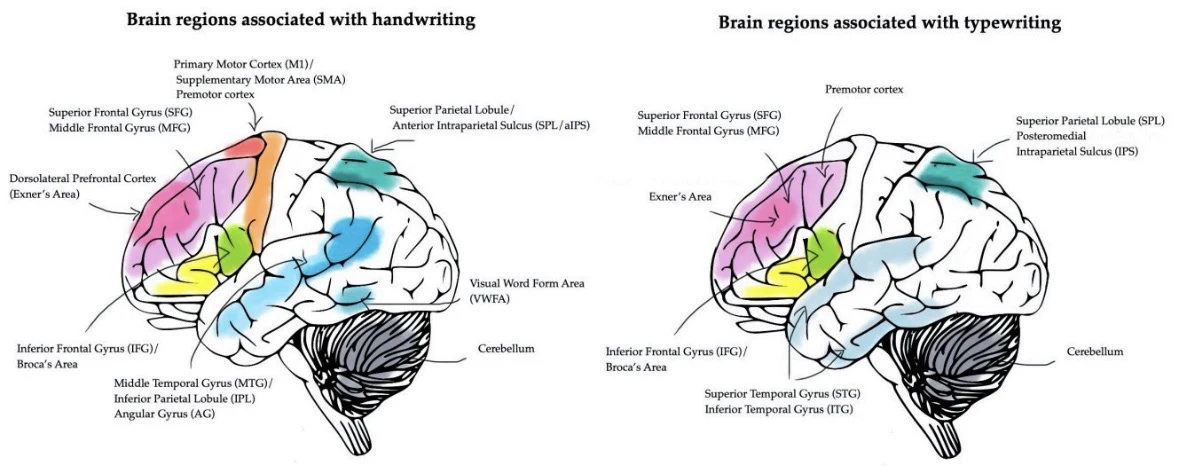
The drawing comes from a 2025 review led by Giuseppe Marano, published in the journal Life. The team pulled together brain-scan studies of adults writing by hand and typing, then drew where each task shows up.
Here is what the review says each colored area does when you write by hand:
- Visual word form area: stores the shapes of letters.
- Superior parietal lobule: plans the movement in space and holds each letter's motor plan.
- Exner's area: turns the letter you have in mind into a hand movement.
- Motor cortex: runs the movement.
- Cerebellum: keeps the stroke precise and on time.
- Broca's area: turns sounds into letters.
- Middle temporal gyrus and angular gyrus: tie how a word sounds to how it is spelled.
In the drawing, typing still lights up much of the same network. Two areas are missing: the strip that runs the movement, and the area that stores the shapes of letters.
In plain words: to write a "b", the brain recalls its shape, plans the stroke and steers the hand. To type a "b", it finds a key. Every key press is the same small tap. Said differently, typing "engages fewer neural circuits, resulting in more passive cognitive engagement."3
What the map does not prove
More brain at work is not the same as more learning. We want to be clear about the gap.
- It is a drawing, not a scan. It sums up many studies run in different ways. The authors say conflicting results "are likely to stem from differences in experimental design."
- It covers adults. The review left out children and teens on purpose, "as their brains are still developing." Studies of young children point the same way: only freehand letter practice switched on their reading circuit, while typing and tracing did not.4
- Activity is not a grade. The best-known classroom result, handwritten notes beating laptop notes, shrank when other researchers repeated it in 2019.5
So our claim is smaller than the headlines. A pencil does not make anyone smarter. It makes the student build each step themselves, and that effort is what makes it stick. Psychologists call it the generation effect: we remember what we produce far better than what we only read.6
Why math needs it most
In math, the working is the learning. A final answer on its own says very little.
- Math is drawn, not typed. Fractions stack, exponents float, a limit sits under its symbol. A keyboard flattens all of it into one line. Researchers at Carnegie Mellon found that writing a calculus-level equation by hand took about a third of the time of an equation editor.7
- The page keeps the thinking. A quick sketch of a graph, an arrow from one line to the next, a step crossed out but still visible. That crossed-out line shows exactly where the thinking slipped.
- The real tests are on paper. On the AP Calculus exam, students handwrite their free-response answers in paper booklets, and that section is half the score.8 Even for the digital SAT, the College Board tells students to bring pencils for scratch work.9 Practice should look like the test.
What it means in a Sophie session
The two jobs turn into five rules Sophie follows every session.
- The student writes, Sophie reads. The student works on paper. Sophie sees the page through their phone or a camera looking down at the desk. No special tablet: a pencil, a sheet of paper, and the phone and computer they already own.
- Every question says how to answer it. Some questions are meant to be talked through. The rest need calculating, and Sophie asks the student to work them on paper. For those, a bare answer is not enough. Sophie reads how they got there, or asks.
- "Let me write it down" means Sophie waits. When a student says they are writing, she does not grade what she heard. She waits for the page.
- Sophie never does the work. She points at the line that slipped and nudges toward the next step. She does not write the next line for them, because writing it is the part that teaches.
- Sophie writes back by hand. When she grades an answer, her short note appears in handwriting, like a tutor's pen in the margin. Learning stays a conversation between two hands.
Not everything is written. "What does this result mean?" is a good question to answer out loud. But when there is working to do, it goes on paper.
Our promise to families
AI can now write almost anything for a student. That is exactly why Sophie won't.
A good session sounds like a conversation and leaves a page your child wrote. The talk is where they ask, explain and get unstuck. The page holds the steps, the slips, the lines crossed out and fixed. It is the proof they did the thinking, and it is what they will do on test day, alone, with a pencil.
Sophie talks it through with them. The pencil stays in their hand.