How Sophie works
How Sophie works: a live tutor for math.
Sophie helps your child learn AP Calculus through live conversation, lessons on screen, and practice on paper. She listens, explains, and reads their notebook as they work toward understanding, one step at a time.

Your first session
What happens, step by step.
About 30 minutes
- Before
The tripod arrives.
It comes free with your first pack. Until then, a stack of books can hold the phone, or your child can snap photos of the page.
- First minutes
Sophie says hi.
Your child says hi back, so she knows the sound works. The phone looks down at the paper, and Sophie checks she can read the page.
- Then
A real conversation.
Sophie asks how they're doing and what they want to work on: tonight's homework, a test coming up, or a topic that feels shaky. Together they make a short plan.
- Most of the time
Math on paper.
Your child works real problems with a pencil. Sophie reads the page and asks the next question. When they're stuck, she gives a small hint, never the answer first.
- The end
One win, and what's next.
Sophie names something your child did well and what they'll pick up next time.
- After
A letter for you.
Sophie writes you a short letter: what your child worked on, what clicked, and what comes next.
More than a chat window
She follows the thinking.
Not just the answer.
A text chatbot can respond to a typed question. Sophie brings voice, visual explanations, and a view of your child's written work into the same tutoring session. The lesson can follow what they say, what they see, and what they put on paper.
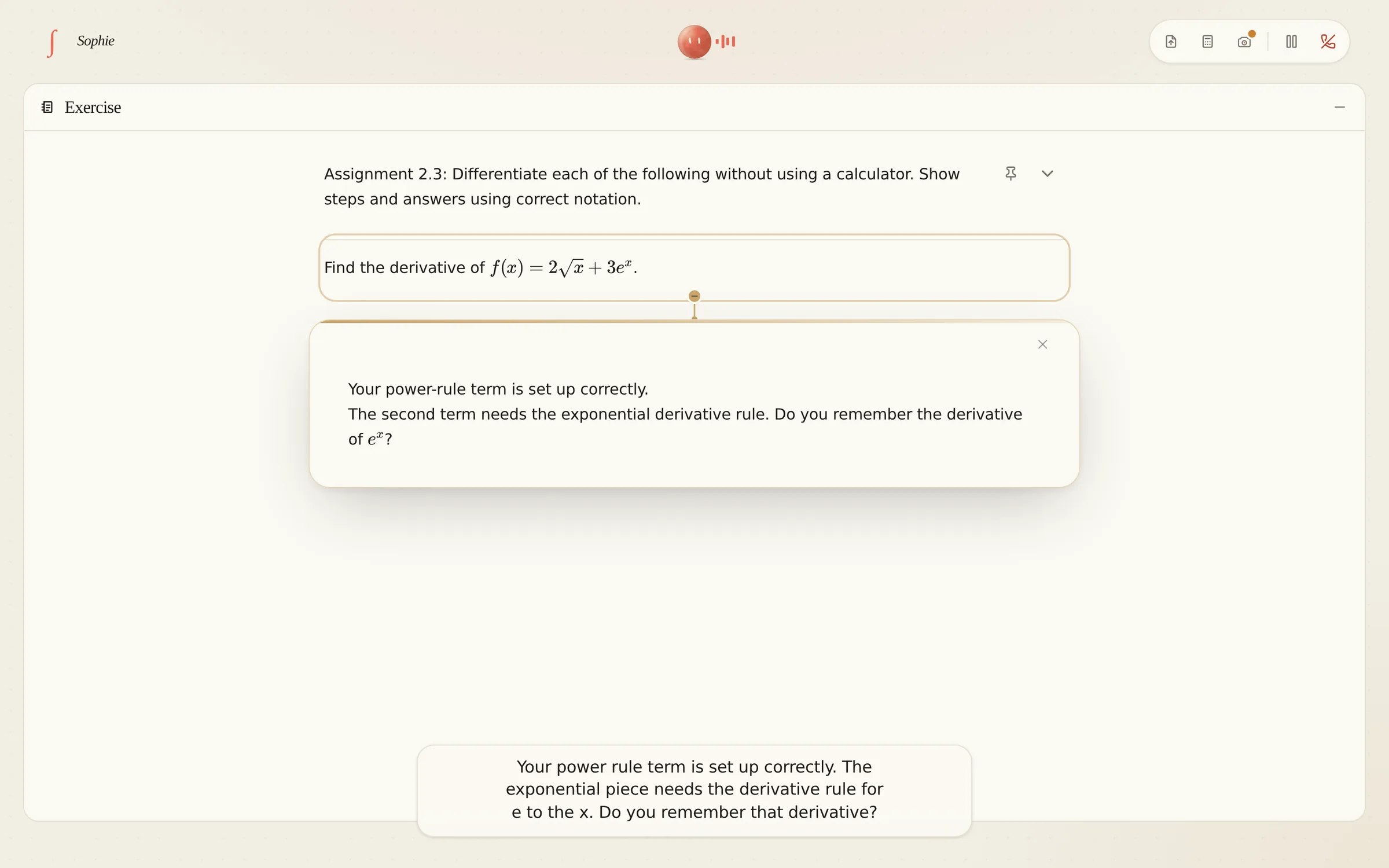
A conversation, out loud.
Your child speaks to Sophie, and she responds by voice. There is room to ask questions, think out loud, and work through an idea at their own pace. They can explain where they got stuck in their own words, then talk through the next step together. The conversation gives Sophie context beyond a final answer.
A screen that follows along.
A graph, a worked step, a new exercise. Sophie changes what is on screen as she talks, bringing the explanation into view when your child needs it. If a rule is unfamiliar, she can write a reference sheet or open a lesson. Your child can look back at the math while they try it on paper.
Real AP material. Personal teaching.
Sophie draws on a library of AP Calculus lessons and exercises, then adjusts to your child's level, speed, and skills as they work together. A student who needs to revisit a concept can spend time on the explanation. A student who is ready to practice can put it to work in an exercise.
Their notebook is part of the lesson.
An iPhone or iPad on a stand shows Sophie the handwritten work. Your child keeps doing math on paper, and Sophie can see where they need a hand. Seeing the steps helps her distinguish a misunderstanding from a mistake in the calculation. Your child practices setting out their reasoning, instead of only entering an answer into a box.
The next session starts here
A tutor who gets to know your child.
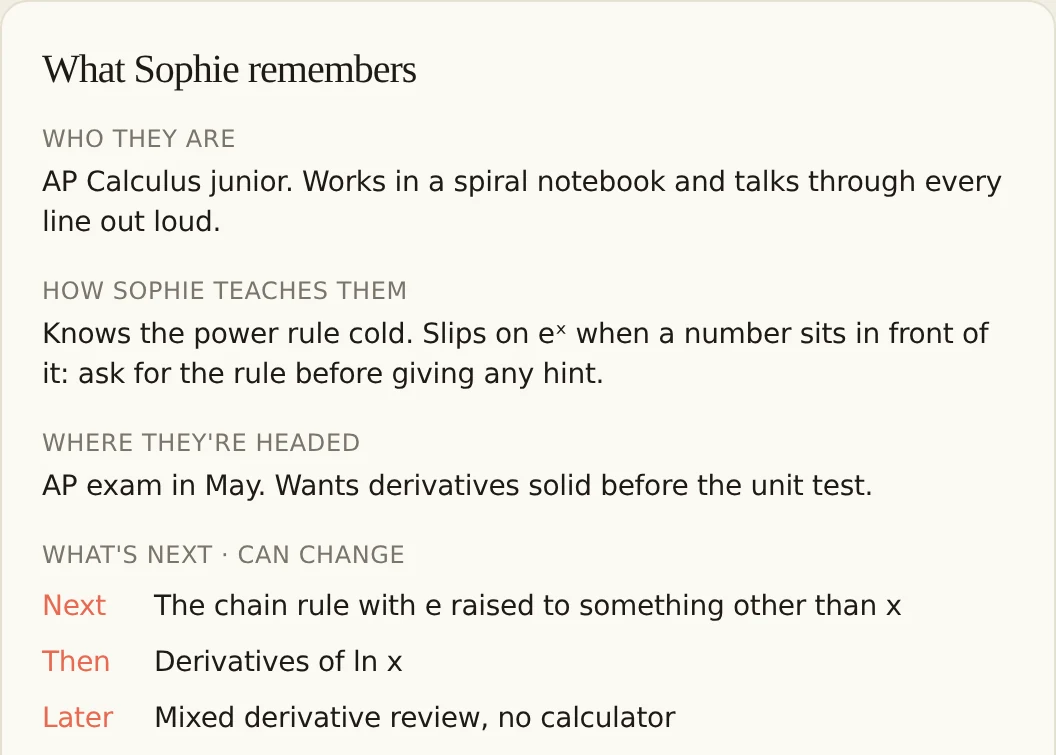
Sophie keeps notes on how your child learns and what comes next, so each session can pick up where the last one stopped.
You can read or clear those memories anytime. The understanding they build is theirs to keep.
Before the first session
Questions parents ask.
A closer look at learning with Sophie, from setting up the desk to following your child's progress.
What subject does Sophie teach?
Sophie teaches AP Calculus, with lessons and exercises for AB and BC. Students can work on a concept they find difficult, practice a skill, or bring a question from class. The session combines explanations with opportunities to work through the math themselves.
What does my child need for a session?
A laptop for talking with Sophie, paper and a pencil for working through problems, and an iPhone or iPad on a stand to show her the page. The phone acts as a desk camera, so your child can keep writing in their notebook without retyping their work.
Can Sophie help with homework or textbook problems?
Yes. Your child can show Sophie a problem on paper through the desk camera, or share a PDF in the session. Sophie can use that material to guide the work. If they do not have a specific assignment, she can choose practice from her exercise library.
Will Sophie do the homework for my child?
Sophie is designed to help your child understand the work. She uses questions, hints, and explanations to help them take the next step, with room for them to try again. Working through the reasoning is part of the session, not just reaching a finished answer.
How can I follow my child's progress?
Your parent dashboard brings together session recaps and skill progress. You can see what your child has worked on and read the notes Sophie keeps to support future sessions. Those memories can be cleared anytime from your account.
Can I sit in?
You're welcome to sit in, anytime. Most kids think better on their own after the first one.
What if my child gets stuck?
Sophie makes the step smaller and gives a small hint. If an idea is new, she can open a short lesson or write a cheat sheet. Your child is never left stuck on their own.
Where can I learn about safety?
Our safety page explains Sophie's approach to working with students. You can also read our privacy policy for details about how information is handled.
Their desk. Their pace.